 WhatsApp
 KakaoTalk
 Line
 Youtube
 Phone

What Is the Hymen? Common Myths and Surgery (Hymenoplasty & hymenectomy)
Does the hymen completely cover the vaginal opening? Does it always bleed during first intercourse? Can a gynecologist tell whether someone has had sex by examining it?
These are common questions, often shaped by things people have heard rather than by anatomy. The hymen is a thin fold of tissue at the vaginal opening. It usually has an opening, varies naturally from person to person, and cannot reveal someone’s sexual history.

What Does the Hymen Actually Look Like?
The hymen usually forms a rim or crescent of tissue around the vaginal opening. It is not normally a sealed barrier that needs to be “broken.”
Its thickness, shape, and elasticity vary. Some people have a noticeable rim of tissue, while others have very little. Its appearance can also change with age, hormonal changes, and childbirth.
This is why describing a hymen as “intact” or “broken” can give the wrong impression. These words suggest that everyone starts with the same structure and that intercourse leaves a predictable change. Neither is true.
Can the Hymen Tell You Whether Someone Has Had Sex?
No. Looking at the hymen cannot establish whether someone has had vaginal intercourse.
There is no particular shape, opening size, or amount of tissue that proves a person’s sexual history. A gynecologist cannot issue a medically valid confirmation of “virginity” based on an examination.
The World Health Organization (WHO) states that so-called virginity testing has no scientific or clinical basis.
Despite this, beliefs about the hymen still place pressure on many women. Some worry that their anatomy looks different from what they expected, or that a partner will misunderstand the absence of bleeding. Neither appearance nor bleeding can answer questions about someone’s past.
Are There Different Types of Hymen?
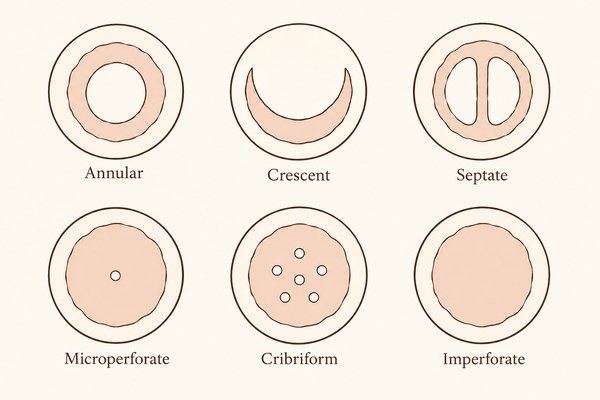
Yes. A ring-shaped hymen is called annular, while a crescent-shaped hymen has tissue mainly along the lower part of the opening.
Other forms include:
- Septate hymen: A band of tissue divides the opening into two.
- Microperforate hymen: There is only a very small opening.
- Cribriform hymen: There are several small openings.
- Imperforate hymen: There is no opening.
A difference in appearance does not automatically mean treatment is needed. What matters is whether the tissue interferes with menstrual flow, tampon use, or comfortable penetration.
If a tampon is difficult to insert or becomes caught during removal, for example, a septate hymen may be one possible explanation. An examination can help determine the cause.
Can the Hymen Completely Cover the Vaginal Opening?
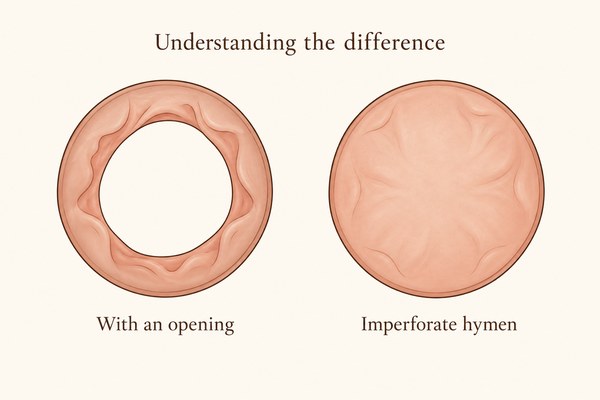
Rarely, yes. An imperforate hymen is a condition present from birth in which hymenal tissue completely covers the vaginal opening.
It may become noticeable around puberty. Menstrual blood cannot flow out and instead collects inside the vagina. Someone may have recurring lower abdominal pain, back pain, or pelvic pressure without visible menstrual bleeding. Difficulty urinating can also occur.
An examination and, when needed, an ultrasound help identify the obstruction and distinguish it from other conditions. Surgery may be needed to create an opening, with the timing based on the symptoms and findings.
Severe pain or an inability to urinate needs urgent medical attention.

Does Everyone Bleed During First Intercourse?
No. Not bleeding during first vaginal intercourse is entirely possible and does not mean someone has had sex before.
Hymenal tissue can stretch without bleeding. If bleeding does occur, it may come from friction or small injuries around the vaginal opening rather than from the hymen itself.
Bleeding should never be treated as something that must happen. If penetration hurts, pause rather than pushing through the pain.
Bleeding that is heavy, does not stop, or occurs repeatedly after sex should be checked. It should not simply be assumed to come from the hymen.

What Is Hymenal Surgery?
“Hymenal surgery” can refer to procedures with very different purposes. The distinction between hymenectomy and hymenoplasty is important.
Hymenectomy: Treating an Obstruction or Symptoms
A hymenectomy removes hymenal tissue that is blocking the opening or causing symptoms.
It may be needed for an imperforate hymen or for another variation that makes menstrual flow, tampon use, or penetration difficult.
Before recommending surgery, a gynecologist needs to confirm the cause. Pain at the vaginal opening can also involve pelvic floor muscles, inflammation, skin conditions, or other problems. Removing hymenal tissue will not address every cause of pain.
Hymenoplasty: Reconstructing Hymenal Tissue
Hymenoplasty, sometimes called hymen reconstruction, changes or reconstructs hymenal tissue.
It cannot restore “virginity,” which is not a medical condition, or make an examination capable of proving someone’s sexual history. It also cannot make bleeding a reliable sign of previous sexual activity.
People ask about this procedure for different reasons, including personal worries, cultural expectations, and pressure from others. These concerns deserve a private conversation in which expectations, surgical risks, and any concerns about personal safety can be discussed without judgment.

When Is It Worth Seeing a Gynecologist?
You do not need an examination just to find out whether your hymen looks “normal.” There is a wide range of natural variation.
An appointment is helpful if you have recurring pelvic pain without menstrual bleeding after puberty, difficulty using tampons, persistent pain with penetration, or repeated bleeding after sex.
You can also come in simply because something worries you. Your doctor can explain the anatomy, discuss possible causes of symptoms, and help you decide whether an examination is needed.

Why Do Gynecologists Ask About Sexual Experience?
When we ask about sexual activity, it helps us choose appropriate tests and plan an examination that suits your situation. It may also be relevant to pregnancy risk or sexually transmitted infection testing.
The purpose is to provide appropriate care. You are welcome to ask why a question is being asked or to explain that you feel uncomfortable. Before an examination, your clinician should explain what is proposed and obtain your consent.
At LANTE OB-GYN in Gangnam, Seoul, our female OB-GYN specialists can help with concerns about hymenal anatomy, menstrual flow, and pain at the vaginal opening. English-language assistance is available.
Your anatomy does not need to meet anyone else’s expectations. What matters is understanding your body and getting help when something causes discomfort or concern.
Medically reviewed by Dr. Yejin Choi, OB-GYN Specialist at LANTE OBGYN


